
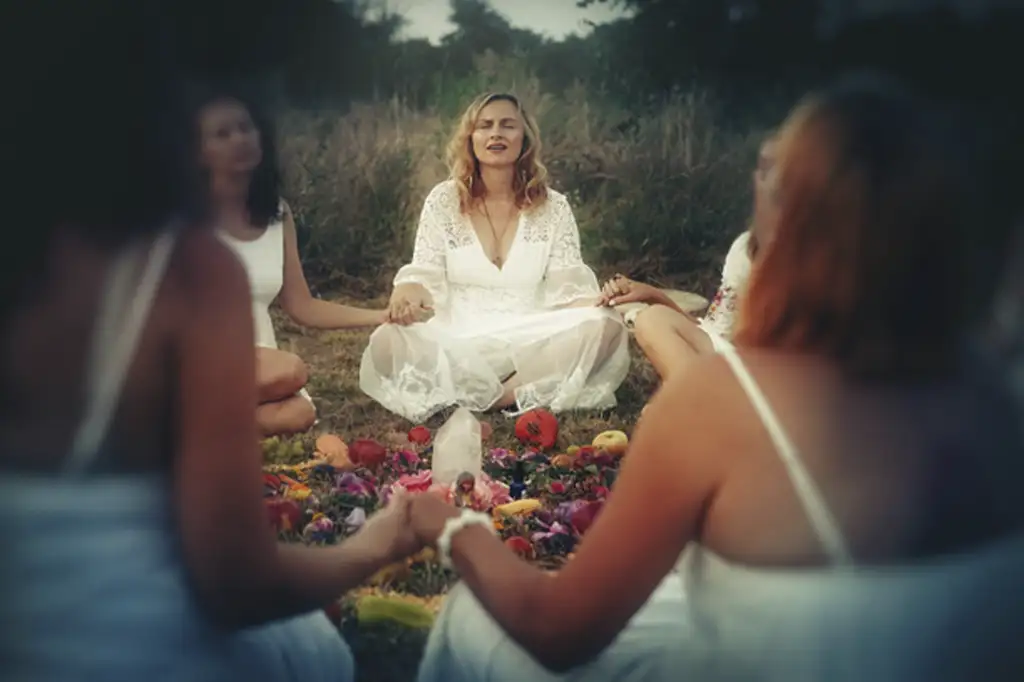
Many women approaching menopause receive information about symptoms to manage and treatments to consider. What they rarely receive is any acknowledgement that something significant is happening. There is no gathering, no menopause ritual and ceremony, no moment where someone looks her in the eyes and says: this threshold matters; you matter; what you are crossing into is real.
And yet, across cultures and throughout history, menopause has been understood as exactly that: a crossing. A rite of passage with its own symbols, its own language, and its own wisdom. The absence of ceremony around it is not a universal truth. It is a particularly modern Western arrangement, and one that many women are beginning to refuse.
This article is for any woman who senses that menopause is more than a biological event, someone who deserves more than a blood test and a waiting room. It explores what honouring this transition through menopause ritual and ceremony can offer, spiritually, somatically, and within community, and gives concrete, practical ways to begin, whether you are standing alone in your garden with a candle or sitting in a circle of women who already know your name.
Why menopause has always deserved to be marked
The Triple Goddess archetype, Maiden, Mother, Crone, is a long-standing framework in feminist spirituality and sacred traditions for understanding the feminine journey. In this model, menopause was the recognised crossing from Mother to Crone: not a decline, but a graduation into elder wisdom and status. Contemporary feminist spirituality has extended this into a four-phase model that more accurately reflects modern lifespans: Maiden, Mother, Maga, and Crone. The Maga phase, the autumn of a woman’s life, begins at menopause. It is a harvest season, a time when accumulated skill, experience, and hard- won insight become the primary resource. That kind of arrival deserves to be marked.
Within Sacred Ama Songlines®, menopause is also understood as a threshold. Rather than focusing solely on what hormones are declining, it asks what is emerging. Every culture develops its own language for these moments. The ceremony itself matters less than the intention to pause, acknowledge change and consciously step into the next season of life.
Many ancestral cultures understood this instinctively. In certain African traditions, a woman receives a new name at menopause, what the Batlokwa people call leina la bokgekelo, an acknowledgement that she is genuinely not the same woman who began the journey. Ojibwe teachings refer to this phase as “Moonpause,” linking it to spiritual deepening and a new relationship with sacred practice. Wiccan croning ceremonies formally welcome a woman into elder status with ritual, witness, and celebration. The common thread across all of these is that her power is not leaving. It is being retained within her, no longer released monthly, now fully hers to carry.
The shift away from ceremony happened gradually as Western medicine began framing menopause as a hormonal deficiency requiring correction. When a threshold becomes only a diagnosis, the language of meaning is often replaced by the language of management. Generations of women have moved through one of the most significant transitions of their lives without acknowledgement, without community, without the ritual language that helps the body understand what is actually happening. That is the gap ceremony is designed to fill.
What ceremony offers that medicine alone cannot
The body recognises significant transitions whether or not the mind has formally named them. Without ceremony, the nervous system may receive no clear signal that one chapter has closed and another has genuinely begun. Ritual, through repeated action, symbolic gesture, and sensory anchoring, communicates to the body what words alone often cannot reach. This is at the heart of somatic embodiment: meaning must be felt, not only understood. When a menopause ceremony incorporates breath, movement, fire, water, and spoken declaration, it creates an experience the body can actually process and integrate.
A woman who marks her menopause alone experiences something meaningful. A woman witnessed by others experiences something categorically deeper. Being seen within community activates belonging at a physiological level, the sound of voices speaking her name, the weight of another woman’s full attention. These are not extras added to make the event feel special. They are the ceremony itself. Studies of mindfulness-based and somatic practices suggest that structured, meaningful ritual can reduce anxiety, support emotional regulation, and help women feel grounded during hormonal transitions, with the nervous system responding to intentional, sensory-rich environments as signals of safety. For example, research into the effect of yoga on menopausal symptoms has shown measurable benefits that support these embodied approaches: a randomized trial on yoga and menopausal symptoms.
Anecdotally, more women describe seeking ceremonially held spaces designed specifically for this transition. These are not generic wellness classes with candles. They are gatherings shaped from the first breath around the particular weight of midlife crossing, the practices chosen in advance, the silence held with care, the stories invited rather than performed, the seasonal rhythms that structure when and how women gather. For a practical example of how a community can shape a ritual specifically for menopause, see this evocative description of a fireside gathering: Gathering in the Gorge, a menopause ritual. For many women, this is the first time menopause has felt like something arriving rather than something departing.
Menopause ritual and ceremony: symbolic elements that give depth
Fire holds what needs releasing. Writing down the roles that have run their course, the identities held out of habit rather than truth, the fears about ageing that have never been spoken aloud, and then burning them is one of the most consistently used acts in menopausal rite. It signals to the body that something is genuinely complete, doing what the decision alone cannot: making the invisible visible and the internal external.
Water, by contrast, holds what is being honoured. Placing flowers in a bowl for each decade of bleeding, each relationship that shaped the passing years, each dream pursued, this is not performance. It is a language that resonates deep in the body. Objects carry meaning in ceremony in ways that transcend the decorative. Candles in red, white, and purple represent the three phases of the feminine cycle; lighting them in sequence marks the passage through each. A self-anointing ritual using lavender or sandalwood essential oil, both traditionally associated with calm and sacred intention, applied to the wrists or sternum with a spoken declaration is a simple, powerful act of reclaiming. (If you have sensitive skin or allergies, do a patch test before applying any essential oil.) For practical guidance on how to perform a gentle self- anointing practice at home, this step-by-step resource can be helpful: how to do a menopause self‐anointing ritual. Engraved jewellery, flowers chosen for their personal significance, and objects gathered from nature all serve the same function: making the invisible transition tangible and real.
Storytelling is not decoration in a menopause ceremony. It is the ceremony. When women gather to name what a woman has lived, what she has carried, and what she is now becoming, they perform an ancient act of witness. A new name spoken aloud, a declaration offered to fire, a prayer said in the presence of women who understand, these words land differently in ceremony than they do in conversation. The context holds them in a way that allows them to settle into the body rather than simply pass through the mind.
Menopause ritual and ceremony: a simple structure to hold at home
You don’t need a dedicated venue or elaborate materials. A clear outdoor space, a contained fire pit or a cluster of candles, a bowl of water, flowers, and a few meaningful objects are enough. What matters more than the objects is the intention held before you begin, taking a few slow breaths, naming the purpose aloud, and agreeing, with yourself or your group, that this time is set apart from the ordinary. That agreement is the threshold you are creating.
A simple menopause ceremony arc runs approximately 20 to 25 minutes and moves through four stages:
Opening (3 minutes):
Gather in a circle or around a central table. The woman being honoured speaks the purpose aloud: “We are gathered to mark the crossing of [Name] into her next season.” Light candles together in shared silence.
Fire or candle ritual (5 to 6 minutes):
Write what you are ready to release on paper, old identities, exhausted roles, fears about ageing, and burn them, speaking a short declaration as each one catches: “I release what has completed itself. I welcome what is becoming.”
Water reflection (4 minutes):
Place flowers in a bowl for each thing being honoured: years of bleeding, relationships formed, children raised, dreams pursued. Speak them aloud or in silence, placing each flower as an act of acknowledgement rather than letting go.
Self-anointing and closing declaration (3 to 4 minutes):
Apply a small amount of lavender or sandalwood oil to the wrists or centre of the chest. Speak aloud: “I anoint myself as a woman who has earned this crossing. I welcome the season ahead.” Close in shared silence, then celebration.
The same arc works entirely alone. Light a single candle, speak the words aloud even if no one else hears, and allow the time to be real. Somatic practice suggests that what the body needs is a signal that this moment has been set apart and named, and you are the one who can give it that, regardless of whether anyone else is present.
Ceremonially held spaces designed for women in this crossing
Some women are ready to step into ceremony with others but aren’t sure where such spaces exist. What makes a genuinely ceremonially held space is intention woven through every detail: the practices chosen with care, the silence tended rather than filled, the stories invited and received with gravity, the seasonal rhythms that give the community its shape. Walking into a space like that feels different in the body, there is a quality of being expected, held, and already known, and it is a world apart from a wellness class dressed with candles.
At Wild Moon Lodge, led by Dr Danielle Arabena in Brisbane’s Clear Mountain region, the Moon Temple gatherings are built around precisely this kind of ceremonial depth. Longer than a class, richer than a workshop, these are community fireside evenings exploring ritual, storytelling, symbolism, and embodied practice. Women in perimenopause and menopause are not an afterthought in these spaces. The entire gathering is shaped to hold the weight of what they are carrying, and the fire is already burning when they arrive. If you would like individual support connected to cyclical health and midlife transitions, Dr Arabena also offers a Menstrual Wellness Consultation – Dr Danielle Arabena.
The Wise Hearth is Wild Moon Lodge’s dedicated pathway for women navigating perimenopause and menopause. It weaves together somatic restoration, nervous system support, and the threads of Sacred Ama Songlines to create something that sits well beyond conventional wellness offerings. Women who attend describe it not as a programme they completed, but as a threshold they crossed, inside a community that was already waiting for them on the other side.
You don’t have to arrive at this threshold alone
In many contemporary Western contexts, menopause is often framed primarily as a medical issue to be managed with the least possible fuss. This is not the whole story. It is a threshold as significant as birth, as worthy of marking as a marriage, as deserving of community witness as any other major human crossing. Women in cultures that have preserved their ceremonial traditions have long understood this. And somewhere in your body, you probably know it too. For information specific to Indigenous and First Nations experiences of this transition in Australia, see First Nations women and menopause.
The menopause ritual and ceremony a woman holds for herself, whether a quiet self-anointing by candlelight or a fireside menopause celebration with women who love her, does something medicine alone cannot. It tells the body: you have arrived. This matters. You matter. That message, delivered through symbol and silence and shared breath, settles into the nervous system in a way no checklist or prescription ever reaches.
You don’t have to create the perfect ceremony, and you don’t have to walk this path alone. What matters is giving yourself permission to acknowledge the crossing. Whether that happens quietly at home or within a circle of women, ceremony reminds us that important transitions deserve to be witnessed. Sometimes the simple act of pausing is enough to change how the next chapter begins.
Whatever this threshold looks like for you, it deserves to be acknowledged. What waits on the other side is worth stepping towards with intention, and there are spaces, and people, ready to stand with you as you cross it.
If you are also exploring embodied work around cyclical health or birth transitions, Dr Arabena has offerings that may support that work: Sacred Birth – Dr Danielle Arabena and the Birth Alchemy Bundle – Dr Danielle Arabena.